
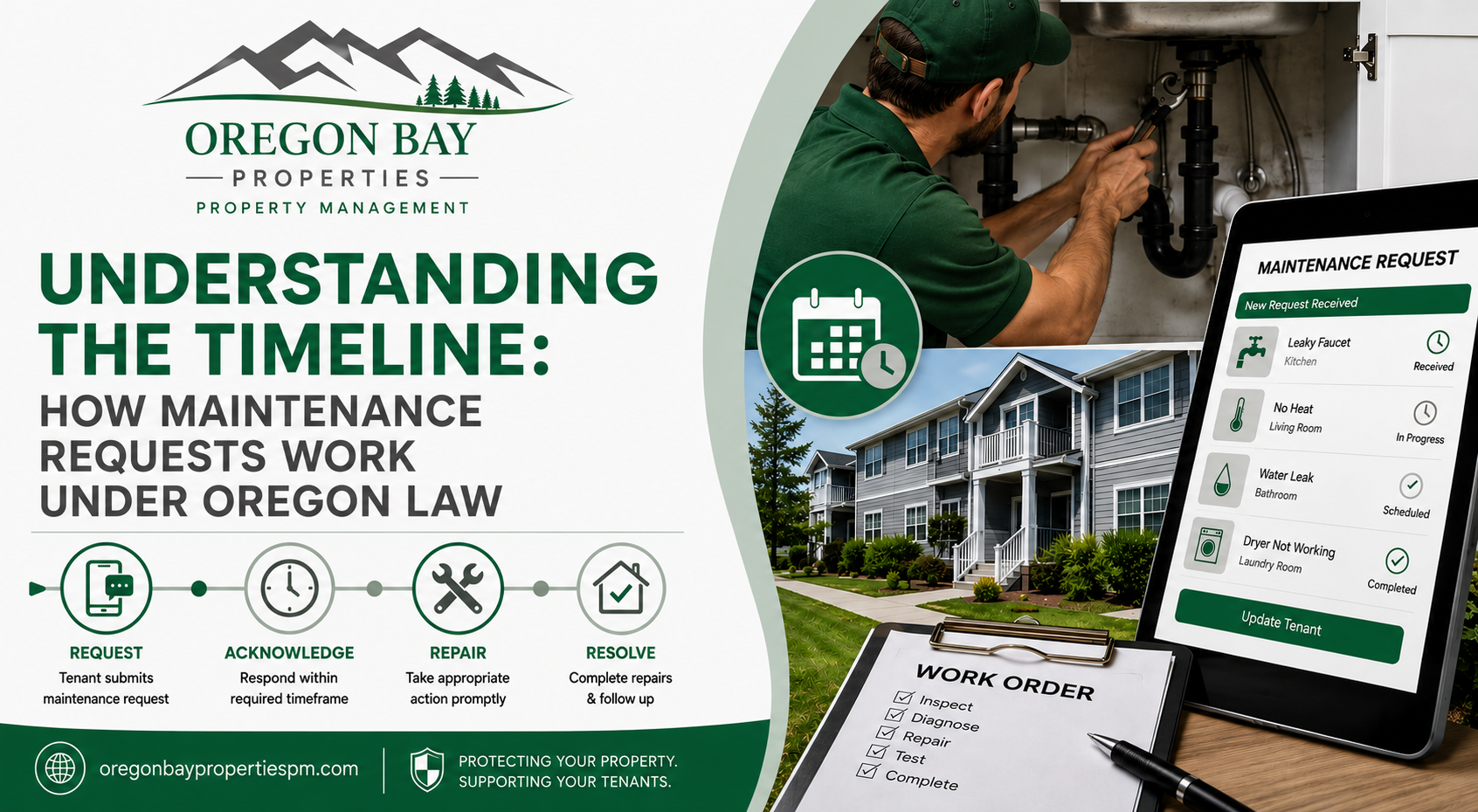
As a renter, few things are more frustrating than a leaky faucet, a broken heater, or a sudden electrical issue. When something goes wrong in your rental home, you want it fixed quickly—and as a property management company, we want the exact same thing! Maintaining a safe, comfortable home keeps our residents happy and protects the property.
However, we often get asked: “How long does a landlord have to fix a problem in Oregon?” Oregon landlord-tenant law (specifically ORS Chapter 90) outlines specific frameworks for maintenance timelines. The timeline depends entirely on the urgency of the issue. Here is a breakdown of how Oregon maintenance request timelines work, what constitutes an emergency, and how real-world factors like vendor availability play a role.
1. Emergency Repairs & Essential Services (Immediate to 48 Hours)
When a maintenance issue threatens your health, safety, or the structural integrity of the property, it is classified as an emergency or a failure of an "essential service."
Under ORS 90.320, landlords are legally required to provide a habitable home. Essential services include:
Running hot and cold water
Working plumbing and sewage systems
Functional heating during the winter
Safe, working electrical wiring and lighting
Working locks on outer doors and windows
The Timeline:
For true emergencies—like a burst pipe flooding the apartment or a total loss of heat in freezing weather—landlords must act immediately. While parts or specific technicians might take a day or two to secure, the property manager must begin addressing the issue right away to mitigate damage and provide temporary solutions if necessary.
2. Minor Habitability Defects (7 Days)
What happens if the issue isn’t an immediate emergency, but it still impacts your daily life? Think of a dripping faucet, a slow-draining tub, or a faulty light switch. Under ORS 90.368, these are often categorized as minor habitability defects.
The Timeline:
If a tenant submits a formal written notice regarding a minor habitability defect, the landlord generally has 7 days to resolve it.
3. General & Cosmetic Maintenance (10 to 14 Days)
If the request is purely cosmetic or non-essential—such as a squeaky cabinet hinge, a torn window screen, or a minor carpet stain—it does not fall under the strict "habitability" timelines of Oregon law.
The Timeline:
For non-emergencies, standard industry practice and Oregon legal guidelines consider 10 to 14 days a reasonable timeframe to schedule, dispatch, and complete the repair.
Behind the Scenes: The Vendor Coordination Factor
While Oregon law outlines the legal expectations, it's helpful to look at how these requests are actually fulfilled. Except for minor fixes our in-house team can handle, most specialized repairs (like HVAC, roofing, major plumbing, and electrical) require licensing and must be handed over to third-party, certified vendors.
Vendor coordination introduces real-world variables that can impact the timeline:
The Scheduling Dance: Once we dispatch a request to a vendor, they have to coordinate with your schedule. If a technician is available on Tuesday, but you prefer they only come on Thursday, the timeline naturally extends.
Peak Season Bottlenecks: During extreme weather events—like a summer heatwave or a winter freeze—local HVAC technicians and plumbers face massive surges in demand. During these peaks, even emergency responses might require a short wait for an available dispatch.
Supply Chain & Parts Availability: Sometimes, a technician diagnoses the problem on Day 1 but finds that a specific, proprietary part needs to be ordered. Oregon law recognizes "reasonable efforts," meaning if a landlord is actively communicating and working to get a back-ordered part delivered, they are fulfilling their legal duties.
We always prioritize your safety and comfort, and we strictly vet our vendors to ensure they offer the fastest response times possible.
Important to Know: The "7-Day Window" for Landlord Entry
One of the most unique aspects of Oregon rental law involves the right of entry after a maintenance request is submitted (ORS 90.322).
Typically, a property manager must give you a 24-hour advanced notice before entering your home. However, if you submit a maintenance request in writing, you automatically grant the landlord or their contracted vendor permission to enter your home without further notice for up to 7 days to complete that specific repair.
Entry must still occur at a reasonable time.
If you want to restrict entry to specific hours (e.g., "only between 9 AM and 1 PM"), you must specify that in your written request.
How Residents Can Help Speed Up the Process
To help us and our vendors get your maintenance requests resolved as fast as possible, keep these tips in mind:
Put it in Writing: Always submit your requests through our online tenant portal. A paper or digital trail ensures nothing gets lost and tracks the exact timeline.
Be Specific: Instead of writing "sink broken," write "the pipe under the master bathroom sink is actively dripping when the faucet is turned on."
Attach Photos/Videos: A quick picture helps our team and our vendors diagnose the problem before they arrive, meaning they can bring the right parts on the very first trip instead of making multiple visits.
Clear the Area: If a technician is coming to fix the water heater or a plumbing line, please ensure the surrounding space is cleared out and accessible.
Our Commitment to You
We take pride in maintaining safe, beautiful homes for all of our residents. By understanding Oregon's legal timelines, managing vendor logistics, and communicating clearly, we can work together to keep your home running smoothly.
Have an issue that needs fixing? Log into your portal and submit a request today!