
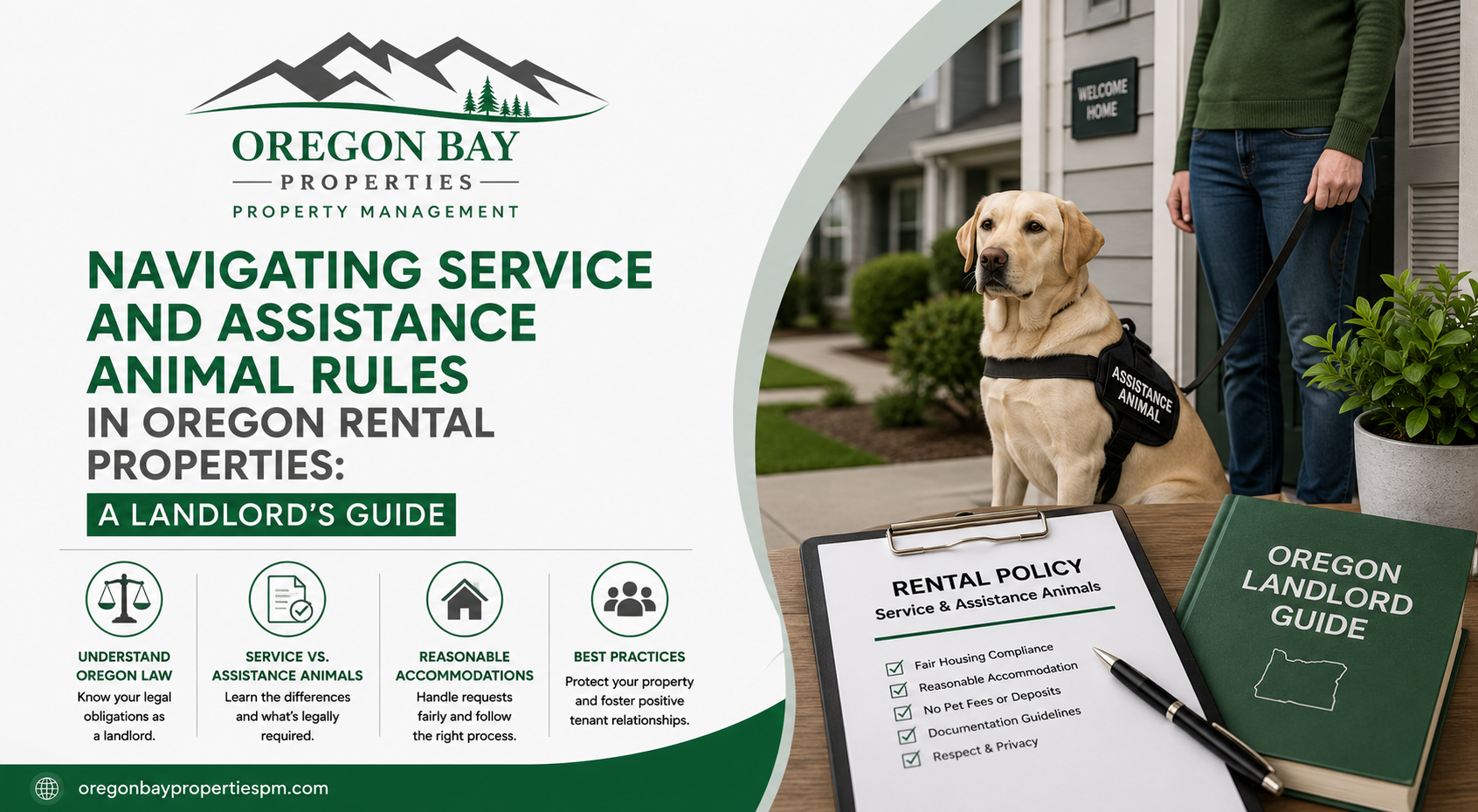
For Oregon rental property owners, maintaining a compliant, welcoming, and smooth-running investment requires keeping up with ever-evolving fair housing laws. One of the most common areas of confusion we see at Oregon Bay Properties involves service and assistance animals.
When a prospective or current tenant requests to live with an animal, "no-pet" policies and pet deposits often spark legal questions. To protect your investment and respect tenant rights, it’s essential to look to the experts at the Fair Housing Council of Oregon (FHCO) to understand your obligations under the law.
Here is a practical breakdown of how to navigate service and assistance animal regulations in Oregon.
1. The Golden Rule: They Are Not "Pets"
Under federal and Oregon fair housing laws, a qualified assistance animal is legally considered an accommodation tool for equal housing access—much like a wheelchair or a ramp—not a pet.
Because they are not pets, your standard property rules regarding animals do not apply in the same way. The FHCO highlights that housing providers cannot charge tenants extra pet fees, pet rent, or pet deposits for an approved assistance animal.
2. Understanding the Terminology
While public spaces (like restaurants or grocery stores) are governed by the Americans with Disabilities Act (ADA) and strictly limit protections to trained dogs and miniature horses, housing laws are much broader.
The Fair Housing Act utilizes "assistance animal" as an umbrella term that includes two main categories:
Service Animals: Animals (usually dogs) that are individually trained to perform specific tasks or do work for someone with a disability (e.g., guide dogs or seizure-detection dogs).
Companion / Emotional Support Animals (ESAs): Animals that provide therapeutic benefits, alleviate symptoms of anxiety or depression, or offer comfort. These animals do not require specific training to be legally protected in housing.
Additionally, Oregon state law explicitly protects assistance animals that are currently in training, meaning landlords must extend the same rules to a verified trainee.
3. What Can an Oregon Landlord Legally Ask?
Landlords often worry about saying the wrong thing when an applicant mentions an assistance animal. The FHCO provides clear guidelines on what is permissible:
If the disability and the need are obvious:
If an applicant is visually impaired and uses a guide dog, or uses a wheelchair and has a dog trained to retrieve items, you cannot ask for verification or documentation. Requesting proof when the need is readily apparent is a fair housing violation.
If the disability or the need is NOT obvious:
If a tenant requests a reasonable accommodation for an unnoticeable disability (such as an ESA for PTSD), you are allowed to request limited verification. You may ask for a brief letter from a qualified, reliable third party (a physician, therapist, or counselor) certifying:
That the individual meets the legal definition of having a disability.
That there is a clear connection (nexus) between the disability and the assistance the animal provides.
⚠️ What you CANNOT ask for: You may never ask for a tenant’s specific medical diagnosis, demand to see detailed medical records, require the animal to perform a demonstration of its tasks, or force the tenant to use a specific, mandatory verification form.
4. Spotting "Online Certifications" vs. Reliable Documentation
With the rise of instant online registries, landlords frequently encounter PDF certificates bought online. The FHCO warns that generic, paid-for online registry badges or certificates are generally not sufficient proof of a disability-related need. A legitimate accommodation request should rely on an established relationship with a legitimate healthcare or service provider.
5. You Still Control Your Property
Accommodating an assistance animal does not mean you forfeit control over your rental property. Landlords still retain substantial protections:
Behavioral Standards: The animal must be housebroken and kept under the owner's control. If an animal is bark-incessantly, acts aggressively, or poses a direct threat to the safety of other residents, you can legally request its removal.
Property Damage: While you cannot charge an upfront pet deposit, the tenant is still 100% financially responsible for any physical damage the animal causes to the unit. You can deduct these repair costs from the standard security deposit at move-out.
No Restrictions Based on Bias: You cannot deny an assistance animal based on arbitrary breed, weight, or size restrictions. Denials must be based on objective evidence of that specific animal's behavior, not hypothetical fears.
Partner with the Experts
Navigating the interactive process of reasonable accommodation requests can feel like a legal tightrope. Making a mistake can result in costly discrimination complaints.
At Oregon Bay Properties, we stay actively aligned with the Fair Housing Council of Oregon's latest guidance to ensure your properties are managed legally, safely, and profitably. If you have questions about handling an upcoming vacancy or updating your lease agreements, reach out to our team today!